About Chemistry, Environment, Waste Management and Green Life Inspirations

19 January 2010

Hazardous Waste

Source :

http://www.epa.gov/waste/hazard/dsw/index.htm

Definition of Solid Waste

These definitions are crucial to understanding the regulation of hazardous waste under Subtitle C of the Resource Conservation and Recovery Act (RCRA). Before a material can be classified as a hazardous waste, it must first be a solid waste. The resources listed below and throughout this website are provided to help determine whether materials are solid wastes and therefore potentially subject to hazardous waste regulation. Users unfamiliar with the Definition of Solid Waste (DSW) regulations may wish to use the Definition of Solid Waste Tool below as an introduction.

The definition of solid waste is in Section 261.2 of the RCRA Regulations.

Definition of Solid Waste resources:

  • DSW Public Meeting - Information regarding the June 30, 2009 public meeting on the DSW final rule
  • DSW Tool - An interactive guide through the DSW regulations, with links to key resources, to help determine if a material is subject to RCRA hazardous waste regulations.
  • DSW Compendium - A collection of written materials addressing specific issues related to the federal definition of solid waste.
  • DSW Federal Register Notices - Provides information on current and past rulemakings and links to Federal Register Notices specific to the definition of solid waste.
  • DSW Resources - Provides links to other resources relating to the definition of solid waste, such the relevant Code of Federal Regulations language and RCRA Training Modules.
  • DSW Implementation Support - A resource for facilities managing hazardous secondary materials under the 2008 Definition of Solid Waste final rule.
  • Environmental Justice Methodology for the DSW Final Rule – Information regarding EPA’s efforts to conduct an environmental justice analysis for the EPA rule.


World Resources Forum Workshop "Towards a New Economic Framework"

Source : http://www.japanfs.org/en/mailmagazine/newsletter/pages/029620.html

JFS Newsletter No.88 (December 2009)

JFS co-founder Junko Edahiro attended the First World Resources Forum
(WRF) in Davos, Switzerland from September 15 to 16, 2009. This article
introduces her presentation on a new economic framework as readers'
food for thought. Your comments and feedback are welcome!

-----------------------------------------------------

Thank you, chairperson, for your introduction. I am honored to be here. Today I will talk about what I believe it will take to create a new economic framework so that our economies won't devastate our ecosphere, on which we all depend for survival. I will present some inspirational and promising initiatives and trends in Asia as well.

I have a multi-career working style, which may become more typical in a new economic paradigm. As a whole, I have been working as an interface among various stakeholders, governments, corporations, academia, NGOs and the pubic as well as a bridge between Japan and the rest of the world.

Japan for Sustainability is a "non-governmental communication platform" with a mission of dispatching information in the area of sustainability from Japan to the world so that we can help move the world and Japan a little more toward a sustainable future. We send out a steady flow of positive and encouraging information every day, from the fountain of hope we feel, despite the worsening situation around the world. Please visit our website to search or browse about what is going on in Japan and in Asia relating to sustainability, including new technologies, new products and services, governments' and citizens' initiatives, and enlightening cartoons!

The traditional Chinese and Japanese written characters for "economy" roughly mean "govern the country" and "save the people." In this deepest sense, economy was something to enhance people's well-being and happiness.

But when societies developed money-based economies, as in the case of most countries in the world, the emphasis shifted toward the "production, consumption and trade of material goods." The mental model most people have is "the more economic growth, the more income, the more well-being and happiness there will be." Money and economic growth became perceived as the ultimate purpose and GDP became a yardstick to measure our progress.

So humanity has been trying hard to grow its economies and increase GDP by increasing industrial production, but this also means increased use of energy, metal, steel and other materials. We have been very successful and we now have a much bigger GDP in most countries.

But we also have two problems. One is that we have exceeded the Earth's carrying capacity. For example, according to the latest "ecological footprint" analysis, we need 1.4 globes to sustain our activities. And the IPCC says that while the Earth can absorb only 3.1 billion tons of carbon from the atmosphere, we are emitting 7.2 billion tons of carbon into our atmosphere each year, more than double the absorption capacity of the Earth.

The other problem we face is that the promised well-being and happiness have not been delivered with economic growth and the increased GDP. This chart shows that although per-capita GDP has increased significantly in Japan, the percentage of people who are satisfied with their lives has been declining. Something is wrong with this picture.

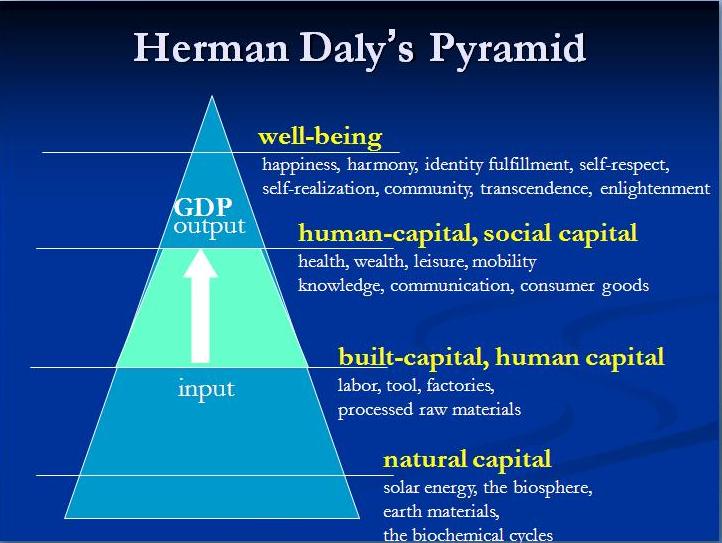
I am sure that many of you are familiar with Herman Daly's Pyramid framework. Our economies and politics have just focused on a narrow area: how to use input for maximum output. Output is measured by GDP, but input is regarded to appear from somewhere without any cost. We don't care about how the input is linked to our natural capital, on which we all depend, and we don't think about how the inputs actually enhance our well-being and happiness.

JFS/New Economic Framework01

In order to create a more encompassing framework, I believe we need "double decoupling." Take CO2 as an example. Our CO2 emissions are calculated like this.

CO2 emissions = (population) x (GDP / population) x (energy / GDP) x (CO2 / energy)

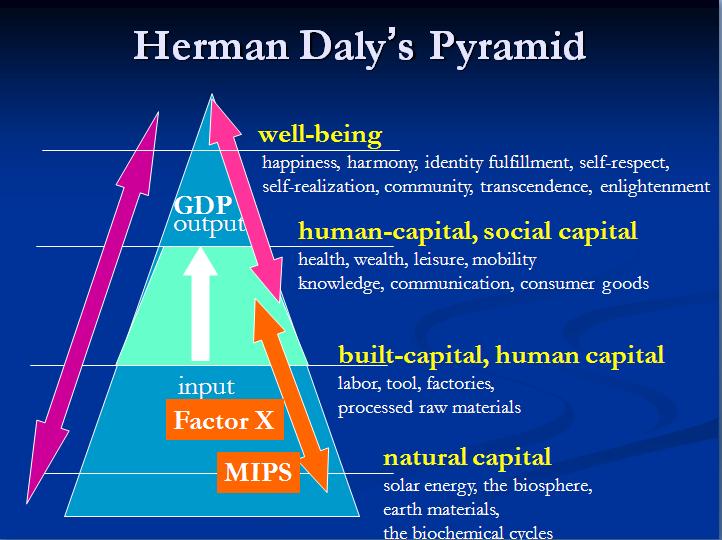
The first decoupling is to break the link between GDP and CO2, which many companies and governments in developed nations have been focusing on. Efficiency, or, I would say "partial efficiency" driven by technologies, is the key here. We now have more efficient technologies and renewable energies for "more production with less CO2."

First-decoupling initiatives, such as Factor 4, Factor 10, MIPS and others, can be plotted here, linking built-capital and social capital to natural capital. We need to link social capital and well-being, and we need to have holistic efficiency to maximize the well-being per unit of natural capital.

JFS/New Economic Framework02

The key here is "sufficiency," and that is driven by our values and mental models. This is what I call the "second decoupling," a decoupling of well-being from GDP.

The Japanese had a long history of living with a mentality of sufficiency, which, unfortunately, we forgot. But if you go to an old temple in Kyoto, you are likely to find a Zen script, saying "I only know that I have enough," or "He who knows enough is enough will always have enough."

It is very encouraging that we now can see increasing attempts and initiatives to focus on sufficiency and holistic efficiency, from natural capital to well-being.

The GPI, Genuine Progress Indicator, a well-known alternative yardstick to measure our progress, eases our obsession with GDP alone by making the distinction between what we really want to increase and what we don't want to increase.

Genuine Progress Indicator
http://www.rprogress.org/sustainability_indicators/genuine_progress_indicator.htm

Have you heard of the "GNH" concept? This comes from Bhutan, a small developing nation in Asia. The former king, more than 30 years ago, said that Gross National Happiness, or GNH, is more important than Gross National Product, or GNP. GNH encourages us to think more deeply about what really matters, and about the ultimate purpose of our work and lives.

Bhutan: Creating Index to Measure People's Happiness
http://www.japanfs.org/en/mailmagazine/newsletter/pages/029065.html

Ask your self this: Do we work and live to increase the GDP of our country? Or do we work and live to enhance our happiness? These are the four categories and nine pillars used to measure GNH and the ecosystem is included as a basis for well-being.

Also from Asia, Thailand has been advocating the "Sufficiency Economy" which was initiated by the King, with three principles: the "middle path," reasonableness and self-immunity to external shocks (like the economic crisis of 1997, triggered by globalization, that hit Thailand hard). These principles are clear in shifting the focus from expanding economic growth to forming a strong and stable foundation for sustainable development, and well-being for all, with local communities and communes as the foundation.

Increasingly many companies, large and small, including multinational companies, after listening to my talk on this, ask me how they can value the GNH concept and the idea of "sufficiency" in their companies. Many companies in Japan now realize that there is only a dead end in ever-lasting pursuit of sales growth.

In my country of Japan, some interesting new trends are revealing fundamental shifts in people's mental models. One is "de-ownership." For an increasing number of people, young people in particular, automobiles, books or clothes are not things to buy and own but just to use for their utility value, when wanted. I have been observing the basis and criteria to define a person's identity shifting slowly from "what you have" to "who you are."

An increasing number of young people in Japan don't seek a "life-long career" at one company, which has long been the norm, but instead want to choose something like what we call the "half-farmer, half-X" lifestyle, for example. The basic idea here is that people pursue farming, not so much as a business, but to grow food for their own family, while being constructively involved in society by realizing their own personal passions and missions, for example, "Half-farmer, Half-musician", "Half-farmer, Half-writer" or "Half-farmer, Half-NGO".

Japan's Growing Trend: Part-Time Farmers
http://www.japanfs.org/en/mailmagazine/newsletter/pages/028996.html

"Half-Farmer and Half-X" to Create Rich Relationship between Community
and People
http://www.japanfs.org/en/pages/028711.html

On the Herman Daly Pyramid, we can plot GPI as a truth-telling alternative to GDP, de-ownership and de-monetization to decouple GDP from well-being and happiness, GNH and Sufficiency Economy as guiding principles and as yardsticks for holistic efficiency, from natural capital up to the well-being of people. We may be able to think of a new indicator called "MIPH," for Material Input Per unit Happiness.

JFS/New Economic Framework03


Thank you for listening.


Written by Junko Edahiro

16 January 2010

Changed Rayon Code of National Examination High School 2009/2010

Last update of Puspendik, has changed Rayon Code.
Here we attach Rayon table new code:

Please download here

15 January 2010

Teknologi Proses Produksi Pupuk ZK (Bagian 1)

by Anita Pravitasari on 30/07/09 at 8:33 pm | No Comment | Print article | Email article


Potassium Sulphate (ZK) biasa digunakan sebagai pupuk pada tanaman

Potassium Sulphate (ZK) atau biasa disebut Sulphate of Potash (SOP) telah dikenal sejak abad ke-14 yang merupakan garam berwarna putih dan memiliki sifat tidak mudah terbakar serta larut di dalam air. ZK digunakan sebagai pupuk yakni sumber senyawa kalium dan sulfur pada tanaman perkebunan seperti rami, kapas, dan tembakau. Di Indonesia pupuk ini tidak disubsidi sehingga harganya relatif tinggi di pasaran. Bahan baku sulfat alami untuk pembuatan ZK yang berasal dari pertambangan antara lain adalah lanbeinite (K2SO4.2MgSO4), leonite (K2SO4.MgSO4.4H20), schoenite (K2SO4.MgSO4.6H2O), dan glaserite (K3Na(SO4)2). Pertambangan sumber batuan tersebut banyak terdapat di negara Rusia, Kanada, benua Eropa, Israel, negara-negara timur tengah, Cina, Thailand, Kongo, dan Amerika Serikat.

Pemilihan proes produksi yang digunakan di dalam suatu pabrik pupuk ZK bergantung pada ketersediaan bahan baku. Secara umum ada 7 proses produksi pembuatan pupuk ZK, yaitu:

1. Dekomposisi KCl dengan Na2SO4
2. Dekomposisi KCl dengan CaSO4
3. Dekompisisi KCl dengan MgSO4
4. Dekomposisi KCl dengan (NH4)2SO4
5. Proses Hargreaves yaitu mereaksikan gas SO2, O2, dan H2O dengan KCl
6. Proses Mannheim yaitu mencampur langsung KCl dengan H2SO4 dengan rasio mol tertentu
7. Pemurnian sumber sulfat alami seperti langbeinite dan kainit

1. Proses Produksi ZK dengan Dekomposisi KCl dengan Na2SO4

Dewasa ini, sumber yang umum digunakan berasal dari Sodium Sulphate Na2SO4 yang dapat diperoleh dari hasil samping dari beberapa proses produksi yakni:

1. Pengolahan bijih chromium
2. Pemurnian flue gas
3. Pembuatan serat (viscose fibres)
4. Produksi HCl, pigmen silica, asam lemak, dan trimethylolpropane
5. Pengolahan limbah asam sulfat

Diagram alir proses ditampilkan pada Gambar 1.
Gambar 1. Diagram alir proses produksi ZK dengan melalui dekomposisi KCl dengan Na2SO4

Gambar 1. Diagram alir proses produksi ZK dengan melalui dekomposisi KCl dengan Na2SO4

Penjelasan proses:
Bahan baku yang digunakan adalah sodium sulphate baik dalam bentuk anhydrous (Na2SO4) maupun dalam bentuk hydrated (Na2SO4.10H2O). Selain itu digunakan juga potassium chloride (KCl) dalam bentuk larutan pada temperatur 20 – 25ºC. Umpan KCl, Na2SO4, dan recycle mother liquor yang mengandung kristalin glaserite K3Na(SO4)2 dan KCl, serta kondensat hasil kondensasi dari uap evaporator diumpankan ke reaktor. Reaksi yang terjadi adalah sebagai berikut:

4Na2SO4 + 6KCl -> 2K3Na(SO4)2 + 6NaCl
2KCl + 2K3Na(SO4)2 -> 4K2SO4 + 2NaCl

Rasio mol Na2SO4 : KCl dibuat sangat berlebih yakni antara 1 : 6 sampai 1 : 10 untuk mendapatkan konversi yang tinggi (96 – 99%), sedangkan untuk rasio mol ZK : Na2SO4 dijaga 2 : 1. Beberapa variasi rasio mol (mr) bahan baku dan produk terhadap konversi yang diperoleh di dalam reaktor ditampilkan pada Gambar 2.

Gambar 2. Pengaruh rasio mol reagent terhadap derajat konversi Na2SO4 menjadi K2SO4

Gambar 2. Pengaruh rasio mol reagent terhadap derajat konversi Na2SO4 menjadi K2SO4

Setelah bereaksi di reaktor, produk ZK dipisahkan di filter dan selanjutnya mother liquor yang terbentuk diuapkan di unit konsentrasi 2 tingkat secara bertahap dan diikuti dengan proses kristalisasi pada temperatur rendah (? 2ºC) untuk tahap 1. Setiap mother liquor yang sudah terpisah baik di tahap 1 maupun 2 akan dipisahkan di filter untuk selanjutnya di-recycle kembali ke reaktor, sedangkan uap dari unit konsentrasi akan dikondensasikan terlebih dahulu dan selanjutnya dikirim ke reaktor.

Selain produk ZK juga diperoleh by-product berupa NaCl. Adapun spesifikasi produk ZK adalah sebagai berikut:
K2SO4: 96%-w
Cl- : 0,5%-w
Na+ : 0,2%-w

2. Proses Produksi ZK dengan bahan baku KCl dan CaSO4

Ada 3 tahapan utama dalam metode proses ini, yaitu:

1. Pelarutan gypsum
2. Konversi satu tahap (T = 25ºC)
3. Siklus amoniak dalam proses

Diagram alir proses dapat dilihat pada gambar 3.
Gambar 3. Diagram alir proses produksi ZK dengan melalui dekomposisi KCl dengan CaSO4

Gambar 3. Diagram alir proses produksi ZK dengan melalui dekomposisi KCl dengan CaSO4

Reaksi yang terjadi dalam proses ini antara lain:

CaSO4.2H2O + (NH4)2CO3 -> (NH4)2SO4 + CaCO3
2KCl + (NH4)2CO3 -> K2SO4 + 2NH4Cl

Adapun reaksi samping:

CaCO3 -> CaO + CO2
2NH4Cl + CaO + H2O -> CaCl2 + 2NH4OH
2NH4OH + CO2 -> (NH4)2CO3

Karakter dasar dari proses ini ialah adanya sistem recovery multistage untuk gas amoniak dan KCl, juga produk ZK yang dihasilka akan selalu mengandung amonium sulfat yang sangat dipengaruhi oleh komposisi mother liquor.

Akhir Bagian 1

Sumber:
Fertilizer Manual, 1967
Chemical Paper, B. U. Grzmil and B. Kic, 2005
http://www.k-utec.com/download/Te04-01.pdf, 2004

12 January 2010

Chemistry Laboratory Glassware Gallery Glassware Photos, Names & Descriptions

Glassware used in a chemistry laboratory is special. It needs to resist chemical attack. Some glassware has to withstand sterilization. Other glassware is used to measure specific volumes, so it can't change its size appreciably over room temperatures. Chemicals may be heated and cooled so the glass needs to resist shattering from thermal shock. For these reasons, most glassware is made from a borosilicate glass, such as Pyrex or Kimax. Some glassware isn't glass at all, but inert plastic such as Teflon.

See More >>

Prison as a five-star hotels


Liputan6.com, Jakarta
(11/01/2010)
Life in prison would imagine the grim daily living.
But the bleakness of it at least would be mild if you inhabit the Women's Detention Center Pondok Bambu, East Jakarta. Legal Mafia eradication teams to get prisoner luxurious rooms and comprehensive facilities in the hotel bathtub Women Rutan Pondok Bambu, recently.


Facilities are available including flat-screen TV, luxurious bathroom, refrigerator, water cooler, so air conditioning. The bed was soft no different in their own homes. Even the room to relax and there was karaoke. There was rarely used as a room housing officers prisoner, provided there is demand.

The problem is, not all the rooms were semewah prison facility. This means that only certain inmates who can occupy that special room. Big alleged discrimination occurred among inmates. A luxury cell inmates admitted to get the goods in his cell for providing others.

But not closed the possibility of the prisoners pay some money to officials to get the crease of this luxury facility. Until the news is compiled, the Rutan Pondok Bambu reluctant to comment about the luxury facilities of this elite prisoners.

11 January 2010

2000-2009: The Ethanol Decade?

Whatever else happened these last 10 years, not many groups would call the time "the era when biofuels such as ethanol came of age." But this is exactly the phrase that the Renewable Fuels Association uses to describe the Noughties.

More precisely, the RFA says that the terrorist attacks of September 11, 2001 forced America to pay attention to the many costs of importing oil and ethanol, available and easy to pump into the fuel supply, became the alternative fuel of choice. During the decade, Americans got used to seeing ethanol in their fuel, and production rates climbed. In 1999, the U.S. produced 1.4 billion gallons. Last year, it was 10.6 billion. In January, 2000, there were 54 ethanol plants in the U.S. Now there are over 200, "with even more under construction."

Of course, the Noughties were tough on ethanol, too, with a lot of company bankruptcies and plant closings. Still, with liquid-fueled engines sticking around for a long time, perhaps ethanol's decade won't last just ten years?

[Source: Renewable Fuels Association]